Free Ground Shipping when you spend $99Save Big with CouponsBuilder Pricing AvailableSave Up To 40% off KOHLER Products!

Browse

1. Why do handles not come with my faucet?

Some manufacturers sell the handles separate from the faucet to give the consumer the ability to mix and match styles. If your bathroom faucet does not come with handles our site will indicate a separate purchase is necessary.


2. Why does my new faucet have reduced flow?

Please keep in mind that all new faucets since 1994 are restricted to conserve water per EPA code mandates. Older faucets had no restrictions. Beyond intentional flow restriction, new installations can sometimes have reduced flow if the lines are not flushed prior to installation of aerators or shower heads. The flow restrictors required for aerators and shower heads can clog, resulting in greatly reduced flow rates. Remove the aerator or shower head and make sure the flow restrictor is not clogged.


3. Can I change the handles on my faucet?

Yes. Many manufacturers offer a wide variety of handle styles to suit your tastes for the kitchen, lavatory, & tub/shower models. Changing handles is simple and takes less than five minutes.

If you are changing from lever handles to knob or porcelain cross handles, you will need to re-orient the right (cold) handle stem stop so the stem stop faces inward.

If you are changing from knob or porcelain cross handles to lever handles, you will need to re-orient the right (cold) handle stem stop so the stem stop faces outward (both left and right handle stem stops should orient to the right).


4. How can I remove mineral deposits from my aerator?

Remove the aerator. Soak it in vinegar overnight and flush it with water, rubbing it with a toothbrush if the deposits are stubborn.


5. My pop-up assembly does not stop the water from draining how can I fix this?

Look under the sink to be sure the strap assembly that operates the stopper is properly adjusted and the nut holding the horizontal rod in the drain assembly is secure. Be sure the stopper is properly adjusted.

Note: The cap on the stopper is not designed to be flush with the flange. A seal is created by the weight of the water, which pushes the rubber seal under the stopper against the flange in the sink.

If your drain stopper has been installed to be non-removable, check to see if any section of the pivot rod or strap assembly hits underneath the counter or sink. If so, the stopper can't drop far enough to create a seal in the sink. Depending on what is blocking the action of the pivot rod or strap, you may be able to rotate the pop-up sink stopper slightly so it no longer bumps against anything under the sink.

If everything is adjusted properly, check the amount of silicone or putty between the flange and the sink itself. (Although a white gasket is supplied with each pop-up to seal under the flange, if a sink has an unusually rough surface in the drain area, it may be necessary to use silicone instead of the gasket.) It is possible to determine if there is insufficient silicone or putty under the flange by using a rubber stopper to seal the drain opening only. You can also press down on the stopper to attempt a manual seal and determine if water is leaking around the pop-up flange. If there is insufficient silicone or putty between the sink and the pop-up flange, water will leak out of the sink into the drain, even with the drain outlet fully closed.

Note:Water will not leak onto the cabinet floor; it will seep into the drain via the overflow holes in the drain body

  • Remove the nut that holds the horizontal rod to the body of the pop-up stopper.
  • Lift the stopper out.
  • Reattach the nut that holds the horizontal rod to the pop-up body.
  • Test to see if water is leaking around the flange by plugging your drain with a rubber stopper.
  • Do not cover the outside of the drain flange.
  • If the leak continues, remove the flange and apply more silicone or putty under the flange.

To remove the flange:

  • Unscrew the large nut under the sink.
  • Pull the flange straight up through the sink. If the flange sticks to the sink, gently pry it loose.
  • Apply a fresh, uniform-round bead of silicone or putty.
  • Reinstall the flange and tighten the nut under the sink.

Note: Do not rotate the flange or pop-up stopper body after re-installation. Rotation may cause the silicone or putty seal to break, which may cause leakage.

Caution: Before using plumber's putty, be sure to read the warning labels to make sure it won't stain marble or attack plastic sinks or rubber components


6. Why is the paint/chrome peeling off my faucet?

Most finish problems are caused by caustic or harmful cleaners. Although your faucet's non-Brilliance finish is extremely durable, it can be damaged by harsh abrasives. Use only nonabrasive cleaners. Harsh cleaners or abrasives can scratch some faucet finishes.

After every use or cleaning, it is always best to wipe dry with a soft cloth to prevent water spotting and mineral build-up. We recommend that you clean and wax regularly. You may use an aerosol furniture polish or floor paste wax for this purpose.

Manufacturers of cleaning agents always have the prerogative of changing their formulation without notice. As a result, most manufacturers cannot endorse any specific cleaner. To remove hard water deposits and soap scum, use a 50/50 mix of vinegar and water


7. The finish on my pop up assembly is tarnished?

For all Metal Pop-Up assemblies manufactured after 1997 you will have to replace the drain flange and stopper. The part number for the stopper is RP5648. You would then attach the appropriate finish suffix to the part number. With no suffix the part will be chrome. The drain flange part number is RP23060. The flange unscrews from the rest of the pop up assembly.

For all Metal Pop-Up assemblies manufactured before 1997 you may need to replace the entire pop-up assembly. The stopper is still available and is a part number RP5648. The drain flange was a part number RP6126. The chrome drain flange is still available but the other finishes are not. If you have another finish you will have to replace the entire drain assembly.

Note: This is what Delta recommends for thier pop-up assemblies.


8. Which is better for my sink, a single-handle or double-handle faucet?

This one’s up to you, and with a bit of research, you can decide what’s right for you. While a single-handle faucet offers convenient control of water volume and temperature, double-handle faucets offer additional styles and spout designs.


9. Will the faucet fit my sink?

Determine your basin configuration (i.e., the number of holes in your sink). If your sink has three or four holes, determine the space between the holes. If your sink has three holes, determine the spacing of the holes.

In addition, be sure to measure the exact dimensions of your Lavatory sink so that your new faucet will fit properly.

Also:

  • Avoid a petite faucet on a big, bold sink, and vice versa.
  • A spout that’s too short may not reach far enough, so choose a faucet that directs water into the center of the bowl (a fixture with a high-arc spout or pull-out spray are wise choices).
  • Make sure your new faucet matches the correct hole drillings in your sink: four-inch centers, eight-inch centers or single-hole.

10. Ceramic Disc Cartridges what does this mean?

It goes without saying that your new faucet should work without dripping. Trends in designs have improved significantly in just the last decade. Taking the place of rubber washer gaskets are to ceramic disc cartridges which last a lifetime. Considered the industry’s hardest, most reliable valving material, single-cartridge and washer-less valving systems use ceramic discs to control water flow and are designed to last a lifetime.


11. How do I clean and maintaining my new faucet?

To care for your faucet, wipe with a clean, soft, damp cloth. The ideal cleaning technique is to always blot dry any water from metal surfaces as often as possible. In addition, buff drying should keep your product looking beautiful. Occasionally apply a non-abrasive polish to prevent water deposits and remove build-up of household soaps, creams and sprays to all finishes.

Finally, never use abrasive cleaners or pads, or chemical cleaners of any kind (including window cleaner) on any product with a protective coating or custom finish. Such cleaners will attack the protective coating and use of products like these will void the finish warranty.


12. How do I install my new faucet?


Reasons To Shop at FaucetDirect.com

  • Our Accomplishments

    400,000+ products shipped - Over 50 warehouses, 30 vendors, 20+ direct-manufacturer relationships - Top 30 Fastest Growing Retailer

  • Safest Place to Shop Online

    Read how we do more to protect your information and transactions.

  • Free Shipping

    Orders over $ 99 automatically receive Free Shipping!*

  • Build.com Network of Stores

    FaucetDirect.com is a Network Store of Build.com. When shopping with FaucetDirect.com, you have access to ALL of our stores. One account - everything home improvement and decor!


Best Selling

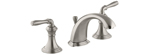
    • Kohler K-394-4
    • Kohler K-394-4
    • Widespread Double Handle Lavatory Faucet from the Devonshire Collection
    • Our Price: $159.88
    • You Save 36%
    • more details


Your recently viewed items
DON'T MISS A DEAL! Sign Up For Email SAVINGS
Details

bill me later

Your Customer Code: 4-45726L